What Midvale area hardness figures look like
Midvale's water comes from two sources, so there is no single number for the city.
The Jordan Valley Water Conservancy District reported these figures in its 2025 water quality report. The average sits just over the line the USGS uses for very hard water, and the range is wide, so two taps can differ a lot.
Which Midvale water do you have?
East-side Midvale water is purchased from Jordan Valley Water Conservancy District, so the JVWCD report applies. West-side water comes from city-owned wells, and the city's pages give no hardness figure.
If you live on the west side, ask Midvale Public Utilities for the annual water quality report at 801-567-7239. Better still, test your own tap with a hardness strip or a lab test, because pipe, location and season all change the result. Do that before buying any equipment.
Not sure your water is hard?
Call and ask how to test your tap. We will help you read the result before you spend anything.
The test-your-tap approach
A softener sized to the wrong number either wastes salt or leaves you with hard water.
- 1
Test a cold tap
Use an indoor kitchen or bath tap and run it a minute first. Record the result in mg/L or grains.
- 2
Count your household
People, showers and laundry loads set daily water use, which sizes the unit.
- 3
Calculate capacity
Hardness in grains times gallons used daily gives grains per day to remove.
- 4
Choose and place
Pick a unit and a location near the main line, a drain, an outlet and a bypass.
We can walk through this with you by phone. If the test comes back soft or only moderately hard, you may not need a softener at all.
Softener, conditioner or filter: what each does
The names get mixed up in advertising. They are not interchangeable.
| System | What it does | What it does not do |
|---|---|---|
| Salt-based softener | Removes calcium and magnesium by ion exchange, which stops scale | Does not filter chlorine or remove sediment. Adds a little sodium |
| Salt-free conditioner | Changes how scale forms so it clings less | Does not remove hardness. Results vary |
| Whole-house sediment filter | Catches sand and grit | Does not soften |
| Carbon filter | Reduces chlorine taste and odor | Does not soften |
| Reverse osmosis at the sink | Cleans drinking water at one tap | Does not protect the water heater |
If you are weighing a tankless unit, see how scale affects it on our tankless water heater page.
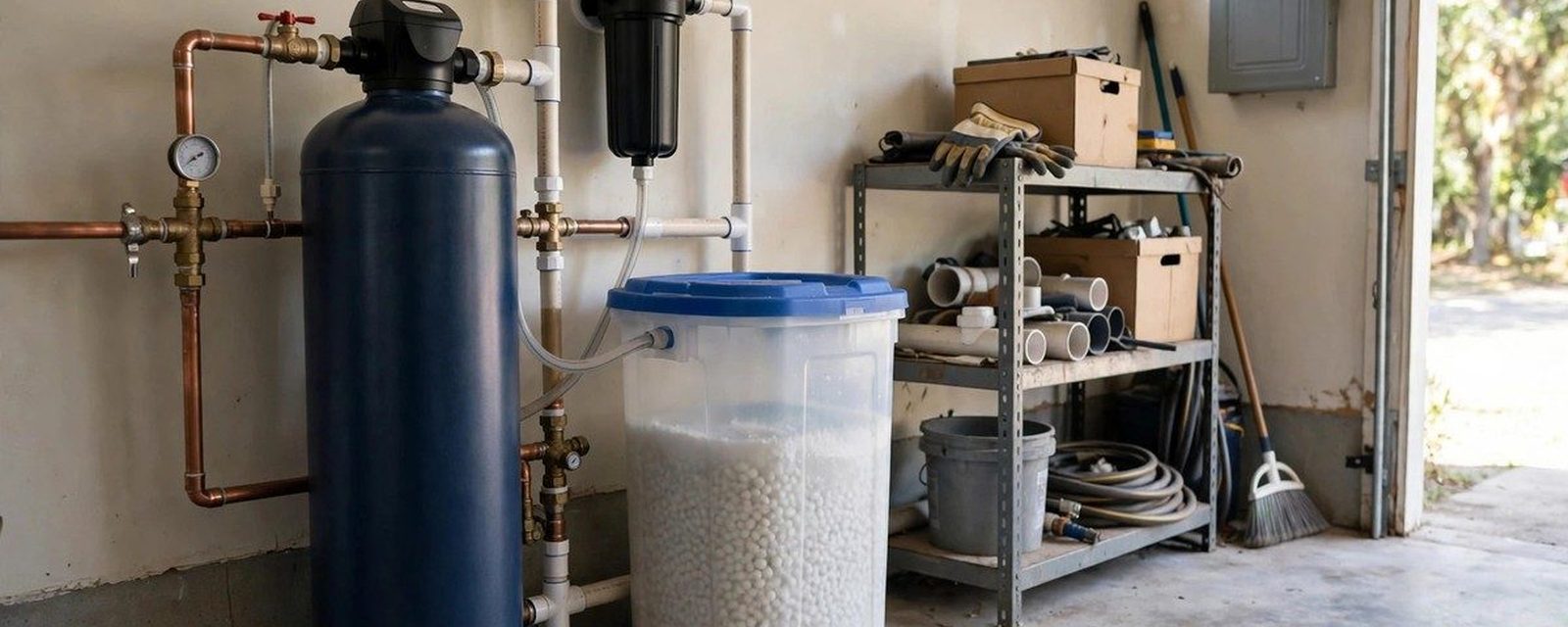
What proper softener installation includes
A good hookup is more than connecting two hoses.
Bypass valve
Lets you isolate the softener for service or when you want unsoftened water.
Drain connection
The unit flushes brine to a drain. An air gap keeps wastewater from siphoning back into the unit.
Hard water tap
Keep an outdoor hose bib on unsoftened water so you do not waste salt on the lawn.
Electrical outlet
The control head needs power, with the cord kept off the floor in a damp basement.
Pressure and flow check
We test pressure before and after to confirm the unit is not choking flow.
Install it yourself or call a plumber
Owners who bought their own tanks often ask us to just do the hookup. That is a reasonable split of the work.
DIY hookup
- Fine with plumbing experience and the right fittings
- Easy to miss the air gap or bypass
- Risk of leaks on old copper or galvanized pipe
- Midvale permit rules may still apply
Plumber hookup
- Correct bypass, drain and fittings
- Handles old galvanized or stubborn shutoffs
- Pressure and leak test before we leave
- Can also replace the main shutoff if needed
Softener repair and relocation
Many calls are about a softener that stopped working, not a new one. Common causes are a stuck valve, a brine tank bridge, a clogged injector, a broken drain line or a power fault. Some units are cheaper to replace once the control head or tank fails, and we will tell you which side of that line yours falls on.
If you are moving a softener during a remodel, protect the drain line and the bypass during construction. A cut regeneration line or a missing drain turns a good unit into a flood.
What affects softener installation cost
Equipment prices vary widely, so we only quote the labor and parts we handle.
Insurance does not cover softener installation. It may cover water damage if a hose fails, so photograph the finished hookup.
Related work
A softener often goes in during other projects. If you are adding a heater, see water heater installation, and if you are opening walls, a plumbing installation visit lets us do everything at once.
Where this guidance comes from
Hardness figures come from the Jordan Valley Water Conservancy District's 2025 water quality report, and hookups follow the International Plumbing Code (IPC) for backflow protection and drains.
Water softener questions from Midvale homeowners
East-side water supplied by JVWCD averaged 182.4 mg/L total hardness in 2025, which the USGS calls very hard. West-side water comes from city wells, so test your tap or ask Midvale Public Utilities.
Use a hardness test strip or send a sample to a lab. Test a cold kitchen or bath tap after running it for a minute, and record the number in mg/L or grains per gallon.
Yes, in many cases. Send the model and capacity so we can check fit, then we handle the bypass, drain and connections. We will say if the unit is too small or too large for your water.
We look at most common faults, such as stuck valves, clogged injectors or broken drain lines. If the control head or tank has failed, we will explain whether repair or replacement is more sensible.
Softened water has a small amount of added sodium. People on a strict low-sodium diet can keep a separate unsoftened drinking tap. Ask your doctor if you are unsure.
It cuts scale inside tanks and heat exchangers, which helps efficiency and life. See tankless water heater for flushing guidance if you do not soften.