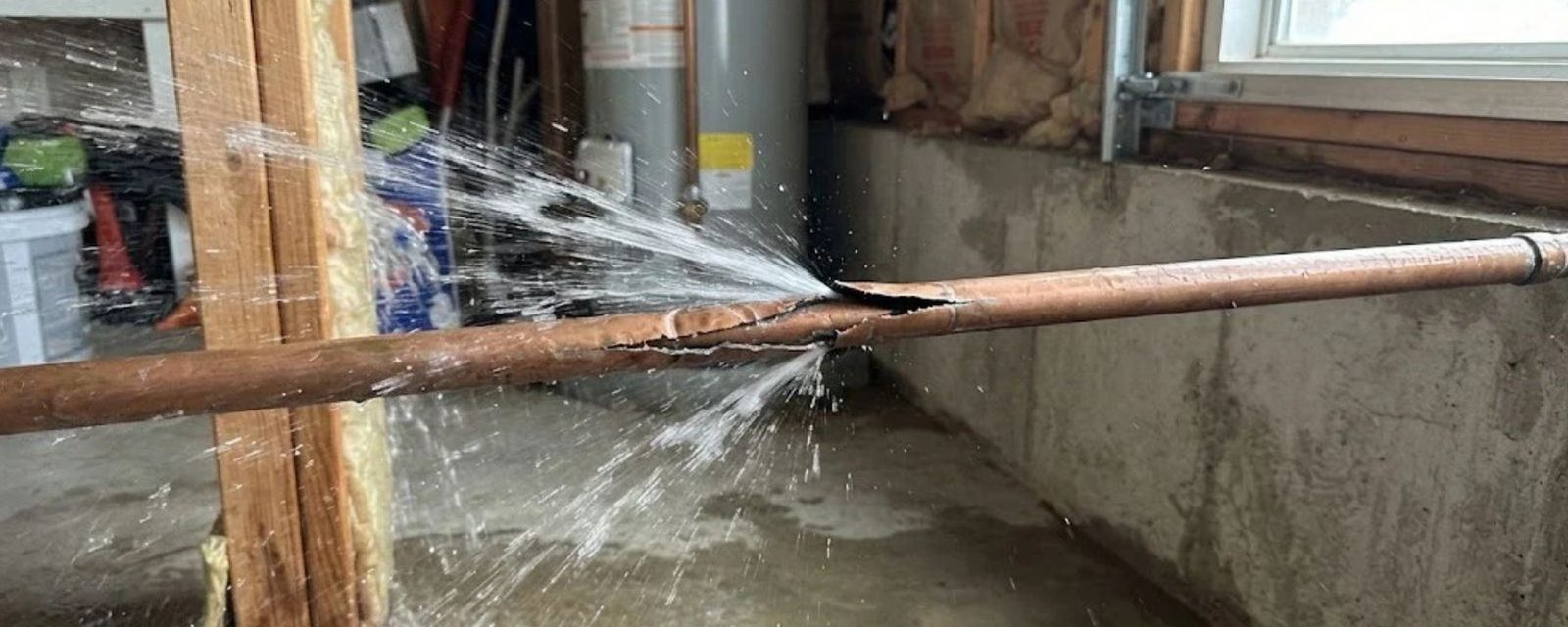
Shutoff steps when a pipe bursts
These steps limit the damage before help arrives. Do them in this order.
- 1
Find the main
Look near the water heater, in the basement, or where the line enters the house.
- 2
Close it fully
Turn a round handle clockwise. A lever valve closes with a quarter turn.
- 3
Drain the lines
Open the lowest faucet in the house and a high one to release pressure.
- 4
Cut the power
Switch off breakers to wet rooms. Do not wade through water near outlets.
- 5
Photograph and mop up
Take photos for your insurer, then move belongings and remove standing water.
If you cannot find the main shutoff or it will not turn, call us and say so. A seized valve changes how we plan the visit.
Water still running?
Our line is answered 24/7. Call and we will help you find the shutoff while we arrange a same-day visit.
When a broken pipe is an emergency
Not every pipe problem floods a house, but these do the most damage when ignored:
- Water spraying from a wall, ceiling or crawlspace
- A cracked or split pipe you can see that will not stop leaking when you close the fixture valve
- Ceiling drywall that is sagging or bulging with water
- A main shutoff that will not close
- Any water reaching an electrical panel or outlet
Inside the house or at the meter? Who handles what
Midvale Public Works runs a 24/7 water emergency line at 801-567-7235, and that line is for problems on the city's side: a leaking main in the street or a failure at the meter. A burst pipe inside your home is not theirs to fix.
If your own shutoff closes the water and the leak stops, the break is on your side. If water keeps pouring toward the street, call the city. When you are not sure, call us and we will tell you which side it is.
Frozen pipe: what to do before it bursts
Ice itself does not usually break a pipe. Pressure builds between the ice blockage and the closed faucet, and the pipe splits where the pressure peaks.
Warning signs
Frost on an exposed pipe, a faucet that trickles or gives nothing, and a cold spot on a wall in a hard freeze.
Safe thawing
Open the faucet, then warm the pipe with a hair dryer or heating pad, starting near the faucet and moving toward the frozen section.
Never do this
Do not use an open flame, a propane torch or a heat gun on a pipe. They can start a fire or burst the pipe.
If it already split
A frozen pipe often only shows a leak after it thaws. Close the main and call so water does not pour out when the ice melts.
Cracked and broken pipe: repair or replace
A split in a straight run of copper can be cut out and replaced with a new section. A pinhole in a pipe that has been pitting from the inside is a different story, because the rest of the line is likely thinning too.
Galvanized steel behaves the same way. It corrodes from the inside, and a repair at one joint often leads to a leak at the next one. In those cases we will talk through whether repiping the affected run makes more sense than patching it again.
Common pipe materials and how they break
The material tells us what failed and what the repair looks like.
| Material | How it usually fails | Typical repair |
|---|---|---|
| Copper | Freeze splits, pinholes, failed solder joints | Cut out section, new coupling or fitting |
| PEX | Freeze swelling, fitting failures | Replace the damaged section or fitting |
| Galvanized steel | Internal rust, leaks at threaded joints | Replace the run, since patches rarely last |
| CPVC | Brittle cracks at fittings, heat damage | Replace the cracked section and fitting |
| Cast iron drain | Cracks, rusted-through sections | Replace the section, covered under sewer repair |
After the leak stops: what to do with the water
Wet drywall and carpet start growing mold in 24 to 48 hours, so drying matters as much as the repair. Open windows, run fans, lift soaked rugs and call your insurance company before you tear anything out.
Do not assume the visible hole is the only damage. A pipe that burst inside a wall can soak insulation and baseboards you cannot see, which is one reason we recommend a leak detection check if the source is not obvious.
What affects the cost of burst pipe repair
A small split in an open basement run and a pipe behind finished drywall are very different jobs.
Many homeowner policies cover sudden pipe bursts but exclude slow seepage and the pipe itself. Document everything with photos, save damaged items until your adjuster looks, and ask the agent what they need.
Temporary fix or permanent repair?
Repair clamps and push-fit couplings exist for good reasons, and they have limits.
Temporary patch
- Clamps and tape buy a few hours
- Fine to stop a spray until help arrives
- Not suited to pipe that is corroded or flaking
- Can fail under full pressure
Licensed plumber's repair
- Cuts back to sound pipe
- Uses properly rated fittings
- Pressure tests before closing the wall
- Looks for the reason it burst
Related repairs after a burst
If the pipe that burst fed a tank, the heater may need a look, and our page on water heater repair covers pressure and relief valve checks. A burst on the line between the meter and the house is usually a water line repair job. We also work in the town just south, and the Sandy plumbing page shows where.
Where this guidance comes from
Repairs follow the International Plumbing Code (IPC) for pipe materials and joints. For a leak in the city main or at the meter, Midvale Public Works sets the procedure, according to the city's utilities pages.
Burst pipe questions from Midvale homeowners
Yes. The line is answered 24/7, including nights, weekends and holidays. We help you with the shutoff over the phone and book a same-day appointment when available.
It is usually where the water line enters the house, often in a basement, utility room or garage near the water heater. In some homes it is in a box near the front foundation. If you cannot find it, tell us and we will guide you.
Call the city at 801-567-7235 for a leak in the street or at the meter. Call us for a break inside the house or on the line from the meter to the house. If you are unsure, we will tell you which.
Open the faucet, then warm the pipe with a hair dryer or heating pad. Never use a torch or open flame. If the pipe is behind a wall or you see a leak, shut the main and call us.
Many policies cover sudden bursts and the resulting water damage. Policies differ, so photograph everything, keep damaged items and call your agent right away.
Often yes. We locate the break first and cut only the opening we need. Larger damage may need more access, and we explain before cutting.
Ask the tenant to close the main or the unit shutoff, then call us with access details. We can work from your instructions.