When a water line problem is an emergency
Some service line problems can wait for a morning appointment. These cannot:
- Water bubbling up through the lawn, driveway or planter between the street and the house
- A meter that keeps spinning after every fixture and appliance is off
- No water at all while the neighbors still have pressure
- A wet crawl space, basement wall or soggy yard with no rain to explain it
- A sudden drop in pressure at every tap in the house
City side, meter and house side
The water line has three parts. Knowing which one is leaking decides who fixes it.
| Part | Where it sits | Who handles it |
|---|---|---|
| City main and tap | Under the street | Midvale City Public Utilities or the water provider for your block |
| Meter and meter box | Usually at the curb or property line | The city. Call Public Works before touching it |
| Service line, meter to house | Under the yard, to the main shutoff | Typically the property owner |
| House side | Inside, after the main shutoff valve | The property owner |
In Midvale, lateral maintenance and ownership for water typically falls to the property owner rather than the city. A leak before the meter is the city's problem, and one after it is yours.
No water, or water pouring from the ground?
Our line is answered 24/7. Call and we will start sorting out a same-day visit.
Shutting the water off safely
Start with the main shutoff inside the house, often near the water heater, in a basement or in a utility closet. A ball valve turns a quarter turn, and an older gate valve needs several clockwise turns and may be stuck.
If that valve will not close or the leak is in the yard before the house, call Midvale Public Works at 801-567-7235 and press 0 for the on-call employee. Do not dig out the meter box yourself. The meter and the city valve are not yours to operate.
Signs of a leak between the meter and the house
A buried line hides its problems. These are the signs that point to it.
The meter runs with everything off
Close every tap and turn off the icemaker. If the dial still moves, the water is leaving the pipe somewhere.
A high bill with no explanation
The city scans meters monthly and flags continuous flow, so a steady leak shows up on the account before you see wet ground.
Low pressure in every room
A pinhole or crack leaks water before it reaches the house. Pressure sags at the farthest fixture first.
Wet or sinking ground
Soft grass, a sunken patch or a green stripe in a dry lawn can mark the line. The wet spot is often not directly above the break.
If you are not sure where the water is going, our leak detection work can trace it before anyone digs.
Old galvanized lines and why they fail
Midvale's own water plan describes much of the distribution system as old and sometimes leaking, and it says galvanized service laterals are replaced with copper or poly when they leak. Galvanized steel rusts from the inside out, so pressure drops and the water can turn brown long before the pipe breaks.
If your house still has galvanized pipe from the meter, a patch may only move the break a few feet down the line. We will tell you honestly when replacing the whole run makes more sense than a repair.
Repair a section or replace the whole line?
Both are real options. The right one depends on what the pipe looks like.
Spot repair
- One clean break in newer pipe
- Smaller trench and a shorter job
- Rest of the line is sound
- Works when the pipe material is in good shape
Full replacement
- Galvanized or corroded pipe along the whole run
- More than one leak in the same line
- Pressure has fallen over several years
- Longer trench but one fix instead of many
How a water line job goes
Most service line work follows the same order, whether it is a repair or a full replacement.
- 1
Locate and mark
We find the leak or the line path, and call Blue Stakes of Utah 811 before any digging.
- 2
Shut off and open up
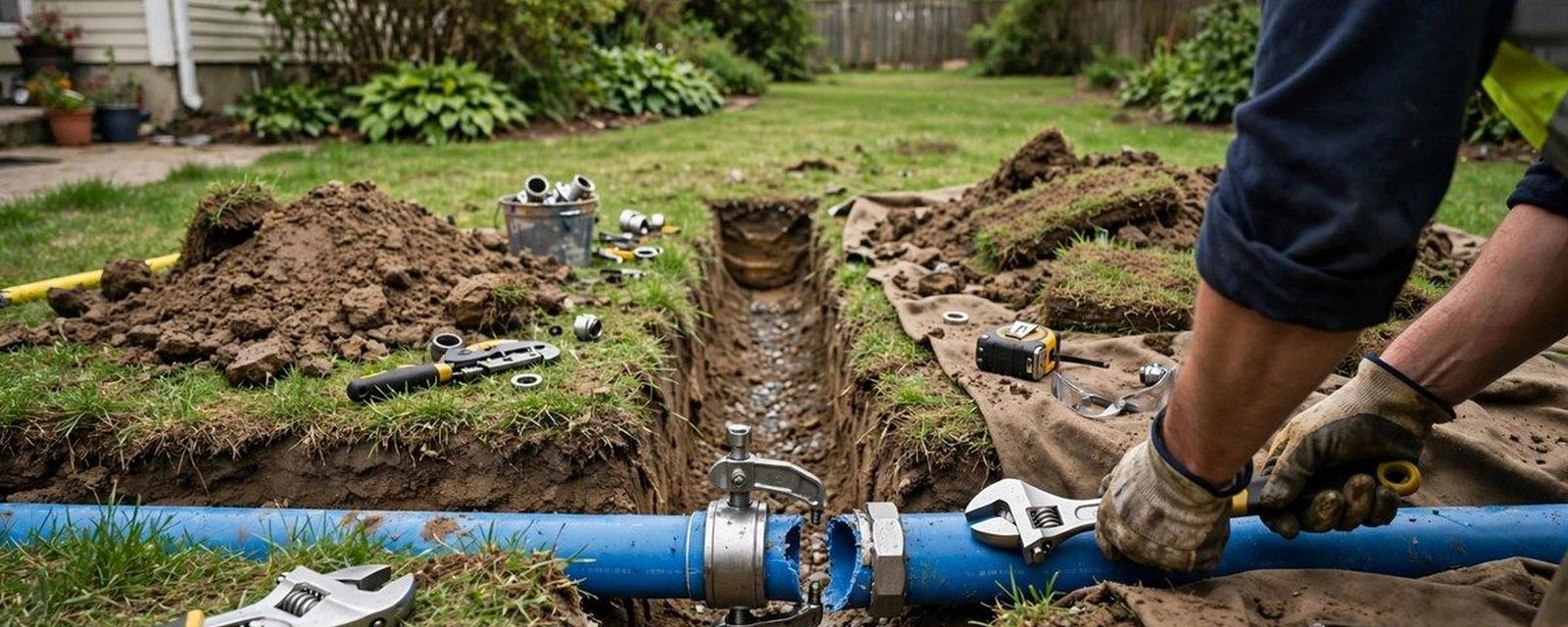
We isolate the line, then excavate to the break or the full run.
- 3
Repair or replace
We join new pipe with proper fittings and restore the connection at the house.
- 4
Test and restore
We pressure test the line, turn the water on and backfill the trench.
Utah requires a call to Blue Stakes of Utah 811 at least 3 business days before excavation, so planned replacements start with that call. Emergency digging has its own process, which we handle for you.
No water or weak water at every tap
Check first whether the neighbors are affected, because a main break in the street is the city's to fix. Leaks and pressure issues go to the Public Utilities line at 801-567-7239, open Monday to Thursday 6:30 a.m. to 5 p.m. After hours, use the Public Works emergency line.
If the city says the problem is not on its side, the service line or a failed main valve is the next suspect. A pressure gauge on a hose bib reads the house pressure in seconds. Normal household pressure is generally 40 to 80 psi.
What affects the cost of water line repair
A line that runs six feet under a flower bed is not the same job as one under a driveway.
Insurance usually covers sudden interior water damage, but many policies exclude the buried line itself or sell it as an add-on. Ask your agent about service line coverage before you start.
What we do not do and who to call instead
We do not repair the city main or the meter. If the leak is on the street side of your meter, Midvale Public Works is the right call, and we will say so on the phone.
Permits are the owner's or contractor's job to confirm. Ask Midvale Building and Safety at 801-567-7200 extension 1016 what applies to a line replacement. For a leak you cannot place at all, start with leak detection, and for a fully corroded house network, see repiping.
Where this guidance comes from
Water service work follows the International Plumbing Code (IPC), and Blue Stakes of Utah asks for a call to 811 before any digging.
Water line questions from Midvale homeowners
Yes. The line is answered 24/7, including holidays. We book same-day appointments when available, and you hear a clear price before work starts.
Turn off every fixture and appliance, then watch the meter. If it still moves and the leak is not inside, the service line is the prime suspect. Wet ground or low pressure supports it.
The city side ends at the meter. Typically the owner is responsible for the line from the meter to the house. Confirm for your address with Midvale Public Utilities.
A leak, a stuck pressure valve, a partly closed shutoff or a city main problem can all do it. Check with neighbors, then call. We can test your pressure at a hose bib.
Possibly. We cannot say for your address. Ask Midvale Building and Safety at 801-567-7200 extension 1016, and tell us what they say.
Jordan Valley Water Conservancy District states that all service lines in its area are non-lead. For west-side addresses on city well water, ask Midvale Public Utilities.
Most Midvale homes are on city water, so this is uncommon. If your property has a well line, tell us on the call and we will tell you whether we can help.