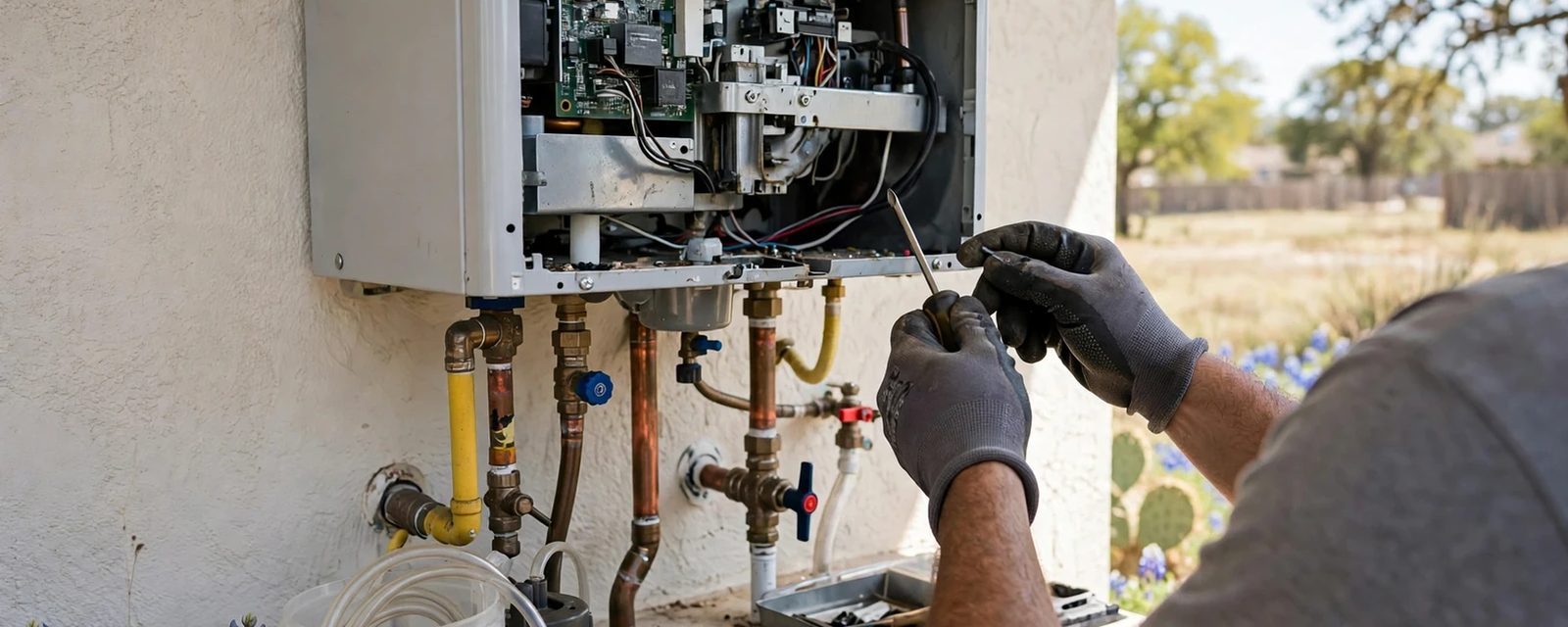
Why a tankless heater needs flushing in Midvale
Minerals in the water coat the inside of the heat exchanger as the unit runs. Scale narrows the passages, the heater works harder, and you start seeing error codes, temperature swings or a unit that shuts off mid-shower.
The Jordan Valley Water Conservancy District reported total hardness in its 2025 water quality report at an average of 182.4 mg/L, with samples from 16 up to 381. The USGS calls water above 180 mg/L very hard, so an average of 182.4 sits just over that line and individual taps can land on either side.
West-side Midvale is served from city-owned wells, and the city's pages give no hardness figure. Ask Midvale Public Utilities for the annual water quality report, or have your tap tested. If your water is on the hard end, yearly flushing is not optional, and a softener upstream is worth pricing out. See water softener installation for how that works.
How a tankless flush works
Most units have two service valves that let us circulate descaler through the heat exchanger.
- 1
Isolate the unit
We turn off gas and power, close the water, and open the service valves.
- 2
Circulate descaler
A small pump moves a mild acid solution through the exchanger, usually for 45 minutes to an hour.
- 3
Rinse and clean filters
We flush with clean water and wash the inlet screen, which catches grit.
- 4
Restart and check
We light the burner, check flow and temperature, and read any stored error codes.
Many manufacturers call for a flush about once a year in hard water. If yours has never been flushed, call sooner, since heavy scale may need more than one pass.
What a gas tankless install needs
Replacing a 40 or 50 gallon tank with a tankless unit is rarely a straight swap. These are the pieces we check first.
| Item | Why it matters | What we check |
|---|---|---|
| Gas line size | A whole-house unit can draw far more gas than a tank, and a 1/2 inch line is often too small | Pipe size, run length and total load of other gas appliances |
| Venting | Condensing units vent through plastic pipe, non-condensing units need stainless steel | Route to the outside, wall or roof clearances, condensate drain |
| Water flow | The unit has a flow rate and a temperature rise limit | Fixtures that run together and winter incoming water temperature |
| Electrical | Even gas units need a small outlet for fans and controls | Outlet location and surge protection |
| Permit | Midvale requires a permit for water heater replacement | We file it and meet the inspector |
If your home is all electric, a tankless unit needs very heavy circuits and often a panel upgrade. In that case a tank or heat pump installation is usually the more practical choice.
Thinking about going tankless?
Call and describe your gas line and how many fixtures run at once. We will tell you honestly if it fits.
Common tankless problems we are asked about
Callers usually describe the symptom, not the part. These are the patterns behind the most common ones.
Error code and no hot water
Codes point to ignition, flame, vent or flow faults. Some clear with a flush, and others need a part such as a sensor or igniter.
Cold sandwich
A burst of cold water between hot ones happens when flow drops and restarts. Scale or low flow settings are the usual cause.
Leak at the unit
Check the service valves and the condensate line first. A leak inside the case needs a plumber, and the unit should be shut off.
Not heating enough
Scale, a clogged inlet screen or too many fixtures running at once can all cut output.
Flush it yourself or call a plumber
A capable homeowner can flush a tankless heater with the right kit. Know the limits first.
DIY flush
- Needs service valves already installed
- Needs a small pump, hoses and descaler
- Easy to miss gas and power shutoff steps
- Does not diagnose why it is failing
Plumber flush
- Valves added if your unit lacks them
- Checks combustion, flow and codes
- Cleans the inlet screen and condensate trap
- Spots vent or gas problems early
What affects tankless pricing
Tankless work varies more than tank work because the house has to support the unit.
Insurance rarely pays for tankless installation or maintenance. It may help if a leak damaged finishes, so take photos before cleanup.
If you smell gas near the heater
Leave the building right away and leave doors open if it is safe. From outside, call Enbridge Gas at 1-800-767-1689 or 911.
Do not switch lights, use a phone indoors or try to find the leak. Once the utility clears the site, we can inspect the heater and its connections.
- Sulfur or rotten egg smell
- Hissing near the gas line
- Dizziness or headache indoors
Related water heater services
If your tankless unit is old and parts are failing, compare the cost with a water heater replacement before spending on another repair. We will tell you honestly when a repair makes sense and when it does not.
Where this guidance comes from
Tankless installs follow the International Plumbing Code (IPC), the maker's venting and gas sizing guidelines, and the local permit rules from Midvale Building and Safety.
Tankless water heater questions from Midvale homeowners
Many manufacturers recommend about once a year, and sooner in very hard water. Hardness varies from tap to tap in the valley, so annual flushing is a sensible default unless your manual says otherwise, and a test of your own tap tells you more than any average.
Some owners do, with food-grade vinegar and a small pump. It works on light scale, but it takes longer than descaler and does not replace a full inspection of the unit.
Often the answer is no without an upgrade. We check pipe size, run length and the other gas appliances before quoting, and we tell you if the unit is a poor fit.
Yes, when parts are available and the unit is worth repairing. Tell us the error code and the age of the unit. If it is past saving, we will say so.
It can save on gas by not keeping a tank hot, but savings vary with how much hot water you use. The higher purchase price and maintenance mean it may take years to pay back.
Not always. If your tap tests very hard, a softener protects the heat exchanger and cuts flush frequency. Test your tap or ask your water utility before deciding.