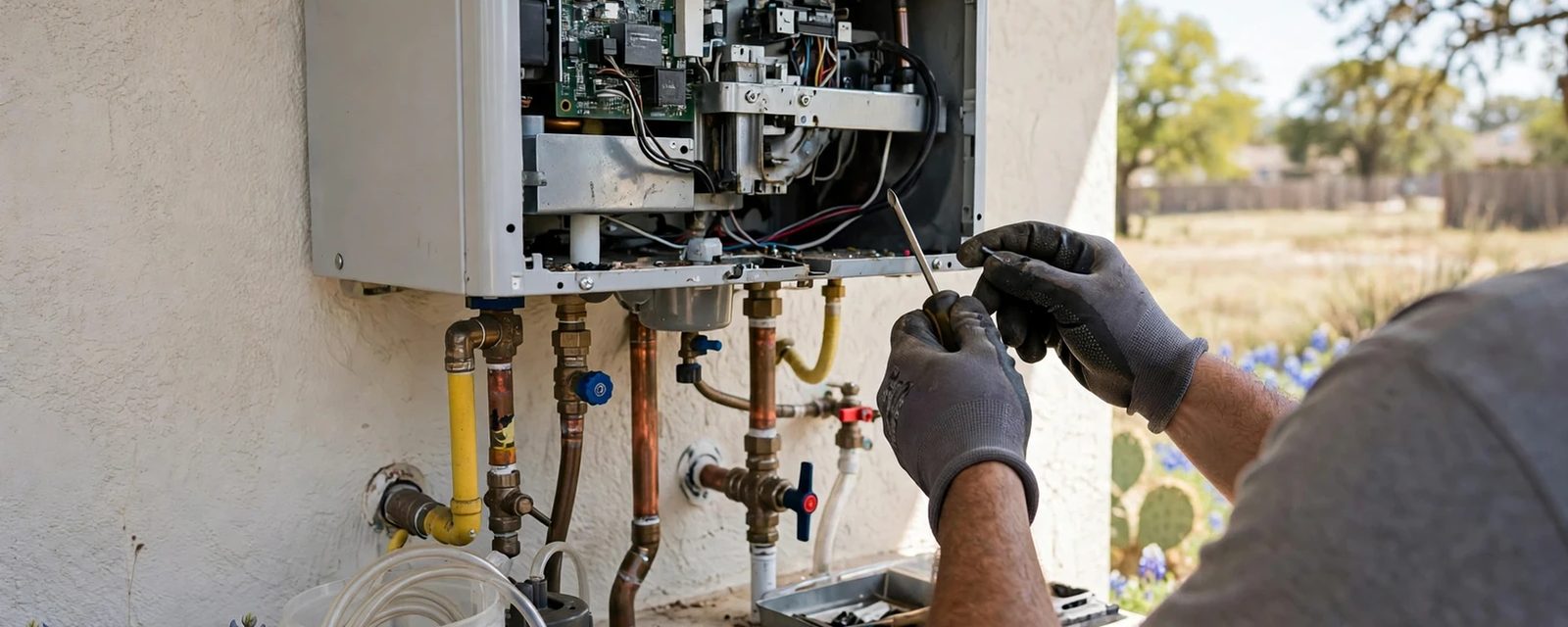
Why one tankless install costs far more than another
Two houses on the same block can get very different bids for the same model. One has a gas line that already feeds the old heater with room to spare, and the other has a thin line that must be upsized. One has an exterior wall right behind the heater, and the other needs a vent run through two floors.
So the honest answer to the cost question is a list of variables, not a number. Gas lines, vent routing, electrical needs, water quality, permit work and the condition of the old plumbing each add or remove hours of labor and parts.
A good bid names each of those items. If a quote is one lump sum with no detail, ask what it assumes about the gas line and the vent before you compare it with another.
Six things that move the price
These show up on almost every tankless job we look at.
Gas line size
Many tankless units draw 150,000 to 199,000 BTU per hour, several times what a 40-gallon tank burner uses. A line that was sized for the tank, often 1/2 inch, may need to be replaced with 3/4 inch pipe.
Venting
Condensing units vent through 2-inch or 3-inch plastic pipe. Older style units need a larger stainless vent. The route and the length decide how many hours it takes.
Condensate drain
A condensing unit produces acidic water that needs a drain and often a neutralizer. A floor drain nearby is easy. A long run to a laundry standpipe is not.
Electrical
Gas units still need a 120-volt outlet for the fan and controls. Electric tankless units need heavy dedicated circuits, which can mean a panel upgrade.
Existing plumbing
Corroded shutoffs, old galvanized nipples or crowded copper make a clean hookup harder. Swapping them while the wall is open is cheaper than doing it later.
Water quality
Hard water scales the heat exchanger. A softener or a scheduled flush may belong in the plan, which adds to the first bill and saves repair calls later.
Comparing tankless bids?
Call our 24/7 line and ask what a visit would cover. Licensed and insured plumbers, clear price before work starts.
What to ask each bidder about
Use this table to line up quotes. A missing answer is a reason to ask, not a reason to guess.
| Item | Why it matters | Question to ask |
|---|---|---|
| Gas supply | Undersized pipe starves the burner and the unit shuts down or underperforms | Is the gas line sized for the unit's maximum input? |
| Vent type | Sets the pipe material, the size and the number of wall penetrations | Where does the vent exit and how long is the run? |
| Condensate | Acidic drain water must go somewhere safe | Is a neutralizer included and where does it drain? |
| Permit | Midvale requires one for water heater replacement | Who pulls the permit and schedules the inspection? |
| Isolation valves | Needed to flush the unit later without cutting pipe | Are service valves part of the install? |
| Old tank | Hauling and disposal take time | Is removal of the old heater in the price? |
If you are still deciding between a tank and a tankless unit, our guide to water heater installation explains what a straight tank swap involves, which helps you see where the extra tankless work comes from.
Tank swap or tankless: where the money goes
The upfront gap and the long-term picture point in different directions.
Replacing with another tank
- Uses the existing gas line and vent in most homes
- Takes about half a day for a standard swap
- Lower upfront labor and parts
- Tank life is commonly cited at 10 to 15 years
Installing tankless
- May need a new gas line, new vent and drain
- Takes longer and touches more of the house
- Higher upfront labor and parts
- Unit life is commonly cited at 20 years with regular flushing
Where tankless saves and where it does not
A tankless unit heats water only when you open a tap, so it avoids the standby heat that a 40- or 50-gallon tank loses all day. That can lower the gas bill in a household that uses modest amounts of hot water. It will not do much for a family running three showers and a dishwasher at once, because the unit has a flow limit.
Most showers run 2.0 to 2.5 gallons per minute and a kitchen faucet around 1.5. Add them up before you pick a size. If your peak demand is 6 gallons per minute and the unit tops out near 5 at your winter water temperature, someone will get a cold surprise.
Incoming water is colder in January than in August, so the unit has to add more heat. A model that looks fine on paper in summer can fall short in winter. Ask the installer to size for your coldest month, not your average.
Midvale requires a permit and inspection for water heater replacement
The Midvale City Building and Safety page lists water heater replacement among the work that requires a building permit and building inspections. That includes a tankless swap, and it applies even when the old and new units sit in the same spot.
Permits are submitted online, and inspection requests are made online at least 24 hours ahead. Only the contractor on record can schedule the inspection, so the licensed plumber who pulls the permit is the one who books it. Building and Safety is at City Hall, 7505 S Holden Street, and keeps Monday to Thursday hours.
Practically, that means you should expect the job to include a permit line and an inspection step. Skipping it can cause trouble at resale and with insurance if a gas appliance is involved. For any rule beyond that, such as clearances or vent requirements, ask Midvale Building and Safety directly.
Numbers that shape a tankless quote
A few figures explain most of the price differences.
That last figure applies to water supplied by the Jordan Valley Water Conservancy District, which serves the east side of Midvale. West-side homes get water from city wells, so ask Midvale Public Utilities for the annual water quality report.
Hard water and the long-term cost
The USGS classes water above 180 mg/L as very hard. JVWCD reported a 2025 average of 182.4 mg/L, which sits right at that line, with readings that ranged from 16.0 up to 381. Scale on a tankless heat exchanger cuts flow and efficiency, and in bad cases it trips the unit's error codes.
A yearly flush through the service valves is the usual fix. If you want to cut scale at the source, a water softener is a separate project with its own cost, and some owners price it together with the heater. Test your tap or read your utility report before deciding.
When to call a pro, and what to have ready
Gas and venting work is not a weekend DIY job. It belongs with licensed plumbers, and a permit goes with it. Before the visit, gather these:
- The make and model plate on your current heater, plus its location
- Whether the heater runs on gas or electricity
- Photos of the gas meter, the gas line and any nearby vent
- How many people live in the home and when hot water use peaks
- Any history of scale, cloudy hot water or low flow
If you smell gas at any point, leave the building right away and call Enbridge Gas at 1-800-767-1689 or 911 from outside. Do not use switches or phones inside. Then call us once the building is safe.
Tankless cost questions from Midvale homeowners
A tank swap usually reuses the existing gas line, vent and water connections. A tankless unit often needs a bigger gas line, a new vent, a condensate drain and extra valves, so there is more labor and more parts even before the unit is counted.
We give you a clear price before work starts, after we see the heater, the gas line and the vent path. A phone number for a tankless install would be a guess, and we would rather not hand you one. We work across Midvale and nearby towns, including Sandy.
It can, because it does not heat a full tank all day. Savings depend on how much hot water you use and whether the installed cost is spread over a long unit life. A large household with heavy simultaneous use may see less benefit.
Yes, with maintenance. East-side Midvale gets JVWCD water, which averaged 182.4 mg/L hardness in 2025, so plan on flushing the unit regularly. For west-side homes, ask Midvale Public Utilities for the annual water quality report.
Yes. Midvale lists water heater replacement as work that requires a building permit and inspections. The contractor on record schedules the inspection, with at least 24 hours of notice.
Yes. Tell us you want to compare a tank and a tankless unit and we will explain what each involves in your house, so you see the real difference in labor and parts.