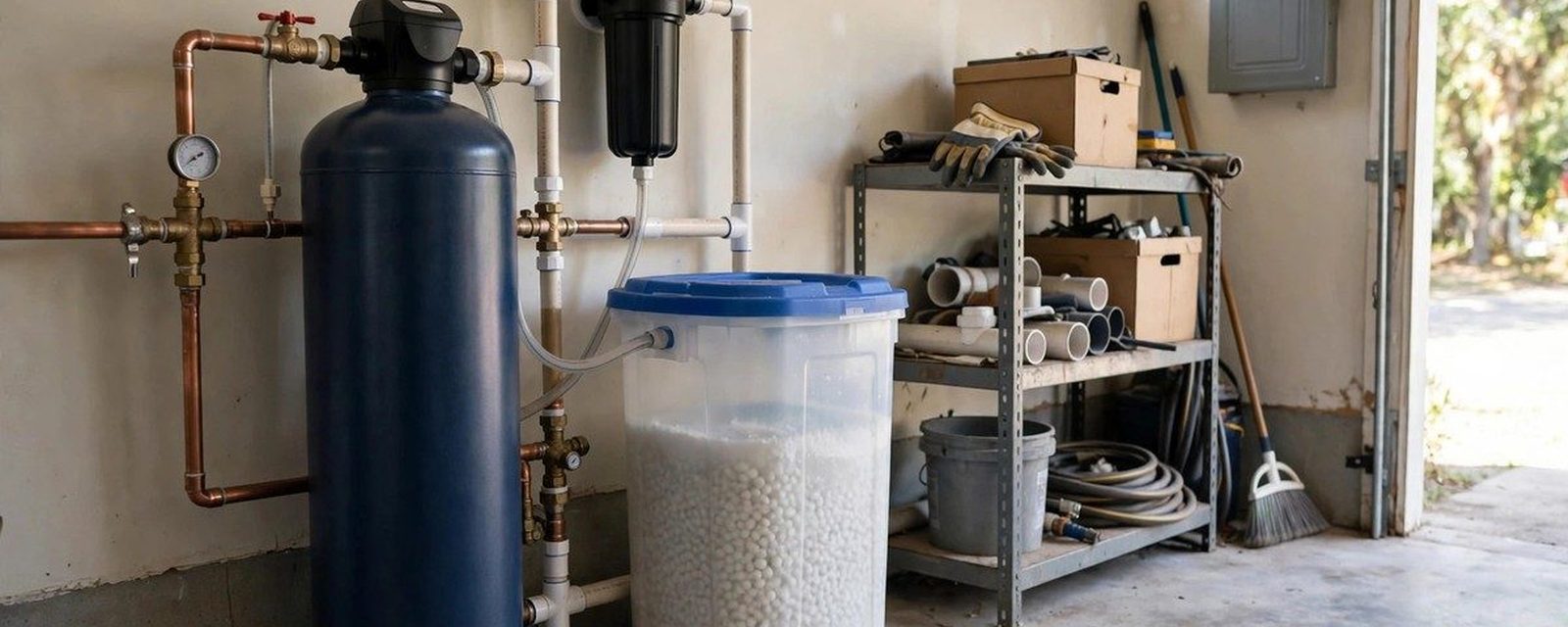
Can you install a water softener yourself?
In most homes, yes, if the pipes near the softener are accessible and you are comfortable cutting and joining them. Many modern softeners ship with push-fit connectors, so no soldering is needed on PEX or copper. A basic install takes a few hours the first time.
The honest limits are plumbing skill, local rules and your own water. If you have never cut a pipe, the cost of a mistake is a flooded garage. If you do not know your water hardness, you may buy the wrong size.
The installation in five steps
Follow the maker's manual for your unit. These steps show the order that works for most salt-based softeners.
- 1
Test the water
Measure hardness at the tap so you can size the unit correctly.
- 2
Pick the spot
Place it near the main line, a drain, a power outlet and level floor.
- 3
Shut off and cut in
Close the main valve, drain the lines, then cut the pipe and fit the bypass.
- 4
Run the drain line
Leave an air gap of at least 1 inch above the drain so wastewater cannot siphon back.
- 5
Start up and set
Fill with salt, program hardness, and run a manual regeneration to test the seals.
Keep the cold-water line to outdoor hose bibs on the unsoftened side. Softened water is wasted on lawns and can add salt to the soil.
Sizing a softener without guessing
Sizing uses two numbers, your daily water use and your hardness in grains per gallon. One grain per gallon equals 17.1 mg/L, so lab reports in mg/L convert with simple division.
| Step | Example math | Result |
|---|---|---|
| Estimate daily use for 4 people | 4 people x about 80 gallons | 320 gallons per day |
| Convert hardness to grains | 182.4 mg/L divided by 17.1 | About 10.7 grains per gallon |
| Grains removed per day | 320 x 10.7 | About 3,400 grains |
| Grains between regenerations | 3,400 x 7 days | About 24,000 grains |
A 24,000 grain weekly load is the capacity you would want a unit to carry at a time. A larger tank regenerates less often, and a smaller tank regenerates more often and uses more salt.
Rather skip the pipe cutting?
Our line is answered 24/7. Call and we will work out a time that suits your schedule.
What Midvale hardness numbers mean for your tank size
Part of Midvale buys water from Jordan Valley Water Conservancy District. Its 2025 Consumer Confidence Report lists total hardness averaging 182.4 mg/L, with a low of 16.0 and a high of 381. The USGS calls water above 180 mg/L very hard, so the east side average sits right at that line, and a house at the 381 end would need a bigger unit than one at 16.
The city says the east side gets purchased JVWCD water while the west side gets city well water. The city pages give no hardness figure, so west-side homeowners should ask Midvale Public Utilities for the annual report. Whichever side you live on, the surest number is the one from your own tap, so test before you buy.
Tools and parts to have before you shut off the water
Missing one fitting means a second trip with the main valve closed. Gather everything first.
- Water hardness test strips or a lab test result
- Pipe cutter that suits your pipe, plus deburring tool
- Three-valve bypass or the bypass built into the unit
- Push-fit or compression fittings matched to your pipe size, often 3/4 inch
- Drain hose, clamps and a way to keep the 1 inch air gap
- Bucket and towels, since lines hold water even after draining
- Salt pellets sized for your unit and a level to set the tank
- A grounded outlet within reach of the power cord
Do it yourself or hire a plumber?
The cost of a small mistake is a leak or a water heater that gets hard water by accident.
Reasonable DIY
- PEX or copper with easy access
- A plain basement or garage wall
- You own a pipe cutter and have used push-fit fittings
- No changes to the drain or electrical needed
Better with a plumber
- Old galvanized or corroded pipe near the main
- Soldering copper in a tight space
- No nearby drain or outlet
- You are not sure where the hot water branches off
- You want the work checked against local rules
Ask Midvale Building and Safety whether your install needs a permit or inspection. The city pages name water heater replacement as permitted work and do not mention softeners, so ask before you cut.
Mistakes that cause callbacks
Most failed DIY installs come down to a short list.
Softening the hot and cold outdoor lines
Outdoor taps should stay on hard water. Add the connection after the hose bib branch.
No air gap on the drain
Without a gap, drain water can siphon back into the brine tank. Leave at least 1 inch.
Wrong bypass setup
Without a bypass, a single repair means no water in the house until the softener is fixed.
Skipping the regeneration test
A manual cycle on day one shows leaks while you are standing there.
When to call a pro
Call a licensed plumber if the main valve will not shut off all the way, if the pipes are corroded or galvanized, or if you cannot find a drain within reach of the hose. Those are the situations where a DIY job turns into a flood. Our water softener installation team can also size the unit from a tap test and make the connections.
If you are also thinking about a larger water project, such as adding a new fixture line, see our plumbing installation service. We serve Midvale and nearby towns, including Sandy, and you can see where else we go on the areas page.
Where this guidance comes from
Hardness numbers come from the Jordan Valley Water Conservancy District's 2025 report, and the hookup follows the International Plumbing Code (IPC) and the softener maker's guidelines.
Water softener questions from Midvale homeowners
Plan on three to five hours the first time, mostly for shutting off, draining, cutting the pipe and programming. Having every fitting on hand before you start keeps it shorter.
The city page we checked lists water heater replacement as needing a permit, but it does not mention softeners. Ask Midvale Building and Safety before you start.
Near the main water line, close to a floor drain and an outlet, on a level surface. A garage or basement wall is common. Avoid spots that freeze.
Not by itself. A softener removes calcium and magnesium that cause scale. If you want a different taste, a separate drinking water filter at one tap is a better match.
Softened water has added sodium. Most people have no issue, but if you follow a low-sodium diet, ask your doctor. A tap that bypasses the softener is an easy option.
Use test strips at the tap, or read your utility's annual report. East-side homes are on JVWCD supply, and west-side homes are on city wells, so check the one that serves you.