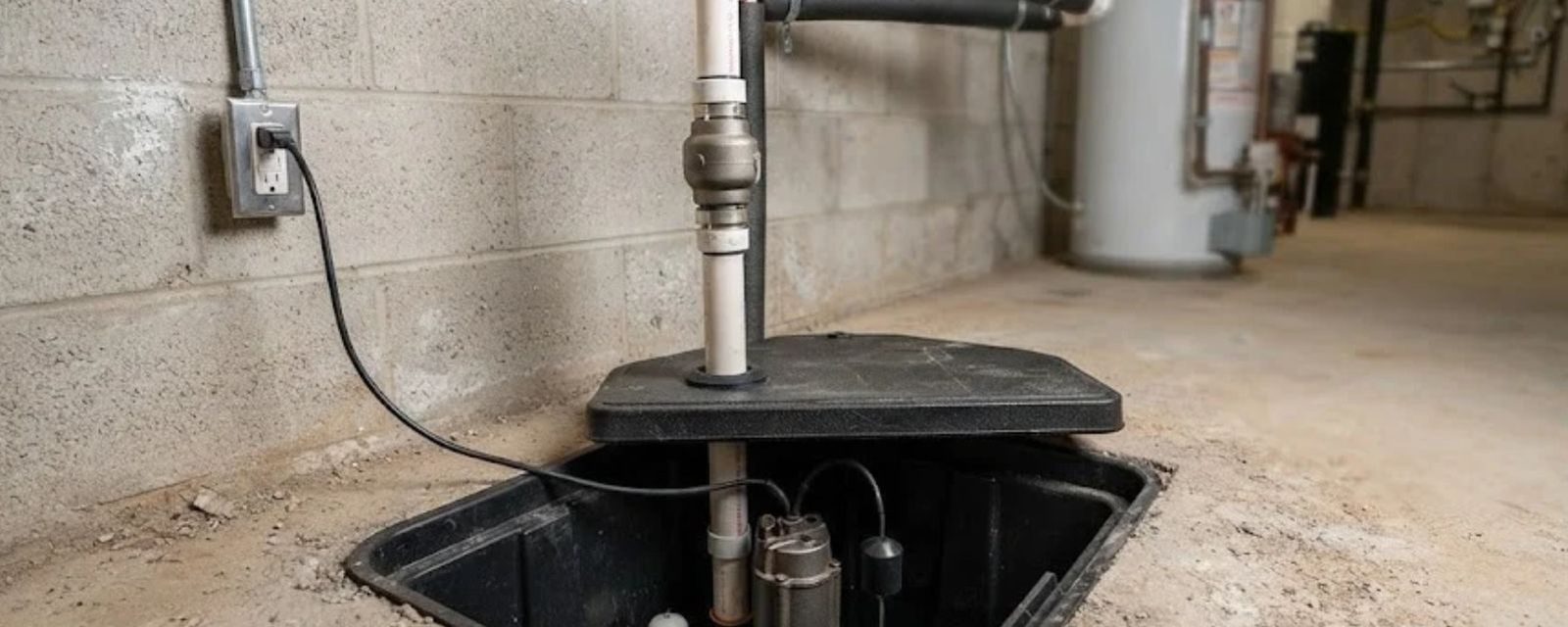
Do you even need a sump pump?
A sump pump matters mainly for homes with a basement or crawl space where water collects below the floor. If your house is on a slab with no basement, no pit and no history of wet floors, you probably do not need one, and we will tell you so rather than sell you one.
If you have a pit in the floor, a pump in it and a pipe leading outside, the pump is the first line of defense when the ground is saturated. When it fails, the basement floods quickly, so it is worth checking even in a dry year. If the basement is wet and the pit stays dry, a broken pipe may be the real source, and leak detection can find it.
When a sump pump failure is an emergency
Call right away if you see any of these:
- Water at or above the top of the sump pit and the pump is not running
- The pump runs but the water level keeps rising
- A burning smell, a tripped breaker or sparks near the pump
- Water seeping up through floor cracks or along the basement wall
- A power outage during rain, with no battery backup
Basement taking on water now?
Our line is answered 24/7. Call and we will line up a same-day visit.
What a failing pump is telling you
The pit usually shows what went wrong before anyone touches the pump.
| What you see | Likely cause | What to do |
|---|---|---|
| Pump silent, water high | No power, tripped breaker or stuck float | Check the plug and breaker, then call |
| Pump hums, no pumping | Seized motor or clogged impeller | Unplug and call |
| Runs constantly | Stuck float or failed check valve | Call, because it will burn out |
| Short bursts, then stops and restarts | Check valve letting water drain back | Call |
| Loud grinding or rattling | Debris in the pit or worn bearings | Replace soon |
Test your sump pump in five minutes
Run this test every few months, and always before spring runoff or a stormy stretch.
- 1
Check the power
Make sure the pump is plugged in to a working outlet, ideally a GFCI one.
- 2
Pour in water
Slowly add several gallons of water to the pit and watch the float rise.
- 3
Listen and watch
The pump should start, empty the pit and shut off cleanly.
- 4
Check the outlet
Water should flow out of the discharge pipe outdoors, away from the foundation.
If the pump does not start with the float up, or the discharge does not run, do not wait for the next storm. Call and we will look at it.
Battery backup and why storms cut the power
The weather that fills the pit often knocks out the electricity at the same time.
Battery backup pump
A second pump sits in the pit on a battery. It starts when the main pump fails or power goes out, and it runs for hours on a charged battery.
Water-powered backup
Some backups use city water pressure and need no battery. They use municipal water, so ask whether that suits your home.
High-water alarm
An alarm sounds when the pit fills, giving you time to act before water reaches the floor.
Generator or inverter
A generator can run the main pump too. It must be sized for the pump's startup load.
Backup pumps need their own testing. Batteries fade, so plan to test the system twice a year and replace the battery on schedule.
Heavy rain and sandbags in Midvale
Midvale City says residents are responsible for protecting their own property in a flood. Salt Lake County keeps free sandbags at the Flood Control Sandbag Shed at 604 West 6960 South in Midvale, open seven days a week from 8 a.m. to 6 p.m. Bring a shovel to fill them.
Sandbags help with surface water at doors and window wells, but they do not pump out a flooded pit. A working sump pump with a backup does that job. If you see a spill or discharge going into a storm drain, report it to Midvale Public Works at 801-567-7235.
Repair the pump or replace it?
Pumps wear out. Fixing an old one often means paying twice.
Repair makes sense
- Pump is only a few years old
- A float switch or check valve has failed
- Plug, breaker or wiring is the issue
- The pit is clean and sized properly
Replace makes sense
- Pump is ten years old or more
- Motor hums and will not turn
- Housing is cracked or rusted
- You want a larger pump or a battery backup
Where the sump water goes
The discharge pipe should carry water well away from the foundation, so it does not circle back to the pit. A check valve on the line stops water in the pipe from running back into the pit each time the pump shuts off.
Whether a sump discharge can connect to the sanitary sewer is a local rule that varies by district, and we do not guess at it. Ask your sewer district, or Midvale Building and Safety at 801-567-7200 extension 1016 if you are changing the pit or finishing the basement, since basement finishes need a permit. For deeper seepage problems, see basement waterproofing.
A basement bathroom needs a different pump
A sump pump moves groundwater. A sewage ejector pump moves wastewater from a basement toilet or shower up to the sewer line. Do not mix them up, and do not drain a washer or toilet into a sump pit.
If a basement bathroom is backing up or gurgling, the ejector may be failing, or the main line may be blocked. Sewer line cleaning rules out the main before anyone replaces a pump.
What affects the cost of sump pump repair
A float switch swap and a new pit with a backup system are very different jobs.
Standard homeowner policies often exclude groundwater and sump failure. A separate endorsement may cover it, so ask your agent before the storm.
Sump pump questions from Midvale homeowners
Yes. The line is answered 24/7, including holidays. We book same-day appointments when available and give you a clear price before work starts.
The pump may be undersized, the discharge may be frozen or clogged, or water is entering faster than the pump can move it. Check that the pipe outside is flowing.
Many last about ten years, depending on how often they run. Pumps in wet basements work harder and may wear out sooner.
If your basement is finished or holds valuables, it is worth considering. Storms that fill the pit often cut the power, and a main pump alone will stop.
It is possible but uncommon. If the home has a crawl space that collects water, a pit can be set in. If it is slab-on-grade with no water issue, you may not need one.
Salt Lake County's Flood Control Sandbag Shed is at 604 West 6960 South in Midvale, open seven days a week from 8 a.m. to 6 p.m. Bring a shovel.