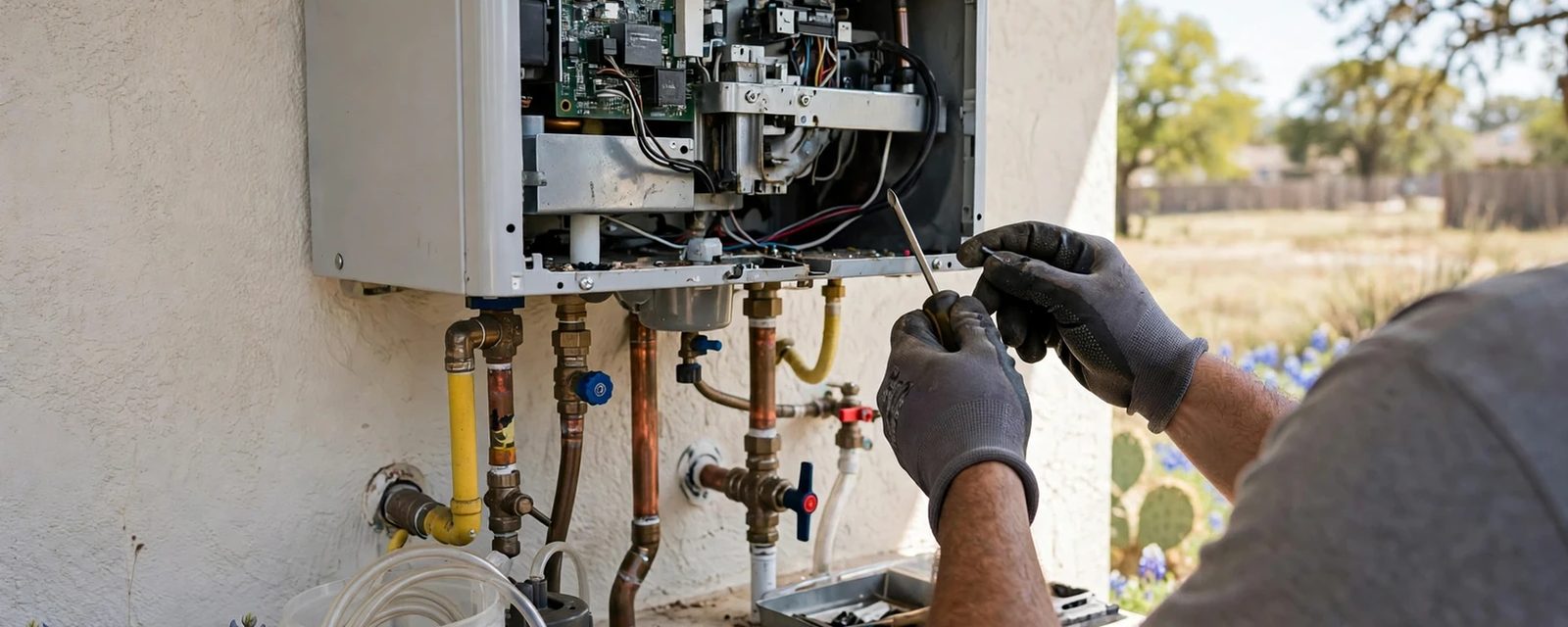
The installation, step by step
Most installs follow the same order, even when the house is different.
- 1
Size the unit
We add up the fixtures you run at once and size for winter water temperature.
- 2
Check gas and power
We measure the gas line against the unit's maximum input and find a 120-volt outlet.
- 3
Plan the vent
We pick a wall or roof exit and a pipe route that meets the maker's clearances.
- 4
Mount and connect
The unit goes on the wall with service valves, gas, water, vent and condensate drain.
- 5
Test and inspect
We fire it, check for leaks and combustion, then the city inspector signs off.
Plan on most of a day for a straightforward swap and longer if the gas line or vent must be rebuilt. Hot water is off while the old tank comes out, so schedule showers around it.
Sizing: the step people skip
A tankless heater is rated by how many gallons per minute it can raise to a set temperature. A shower at 2.0 to 2.5 gallons per minute, a dishwasher around 1.5 and a kitchen tap near 1.5 can all run together in a busy morning. Add those up and you land near 6 gallons per minute.
The rating drops as the incoming water gets colder. A unit that delivers a strong flow in August may fall short in January, when the same water needs many more degrees of heat. Size for the coldest month, not the average.
If two bathrooms are used at once every morning, a single unit may be enough or two may be better. We talk through your habits before we recommend anything.
What a homeowner can do and what needs a licensed plumber
Some prep saves time. The gas, vent and water connections do not belong in a DIY plan.
Reasonable to do yourself
- Clear the area around the old heater
- Take photos of the data plate and gas meter
- Note your peak hot water use
- Make sure the unit location is reachable and lit
Leave to a licensed plumber
- Gas line sizing and connections
- Vent routing and sealing
- Pressure and combustion checks
- Pulling the permit and booking the inspection
Thinking about going tankless?
Our line is answered 24/7. Licensed and insured plumbers, clear price before work starts.
Hard water in Midvale and what it does to a tankless heater
The Jordan Valley Water Conservancy District reported 2025 total hardness at an average of 182.4 mg/L, with a low of 16.0 and a high of 381. That is about 10.7 grains per gallon. The USGS calls anything over 180 mg/L very hard. JVWCD supplies the east side of Midvale, while the west side uses city wells.
Hard water leaves calcium scale on the heat exchanger of a tankless unit. Scale narrows the water passages, lowers flow and makes the unit work harder to hit its set temperature. Over time that shows up as error codes, lukewarm showers and noise.
You can check your own water before you buy. Test your tap with a hardness strip, or read the annual water quality report that Midvale City issues. For west-side homes, ask Midvale Public Utilities because JVWCD figures do not describe city well water. Then plan on a regular flush, which is the practical answer to scale.
How to flush a tankless heater
Units with service valves can be flushed in about an hour. Follow the maker's manual for exact volumes.
- 1
Power down
Turn off the gas or electric supply and close the cold and hot isolation valves.
- 2
Connect hoses
Attach one hose to the hot service port and another to the cold, with the far ends in a bucket or pump.
- 3
Circulate descaler
Pour a food-safe descaling solution into the bucket and circulate it through the unit for the time the manual lists.
- 4
Rinse and restore
Flush with clean water, remove the hoses, open the valves and restore power.
Many owners flush once a year, and homes with very hard water may flush more often. Without service valves, a flush means cutting pipe, so ask for those valves at install. If you would rather not do it yourself, our tankless water heater page explains what a service visit covers.
Signs the unit needs attention
These symptoms often trace back to scale or a setup problem.
| Symptom | Likely cause | First step |
|---|---|---|
| Water runs lukewarm at full flow | Scale or undersized unit | Check the manual's flush interval |
| Error code on the display | Blocked heat exchanger or vent issue | Look up the code, then call a plumber |
| Rumbling or popping noise | Scale boiling on the exchanger | Schedule a descaling flush |
| Cold slug between uses | Normal for most units | Run hot water a few seconds longer |
| Pilot or fan will not start | Gas, power or vent problem | Do not retry repeatedly. Call for service |
Permit, inspection and the final check
Midvale City lists water heater replacement among the work that requires a building permit and inspections. Inspection requests go in online at least 24 hours ahead, and only the contractor on record can schedule one. Plan the inspection into your install day or the day after.
If your project also touches the gas line or the vent through a wall, mention that to Midvale Building and Safety when the permit goes in. They can tell you what else they will want to see. We handle that paperwork on jobs we do.
When to call a pro right away
Some symptoms are not about comfort. They are about safety, and they do not wait for a convenient appointment.
- A smell like sulfur or rotten eggs near the heater or the gas meter
- Soot or scorch marks on the unit or the vent
- Water pooling under the heater or dripping from a vent
- A carbon monoxide alarm that sounds
If you smell gas
Stop what you are doing and leave the building, leaving doors and windows open if it is safe to do so. From outside, call Enbridge Gas at 1-800-767-1689 or call 911. Do not use phones, light switches or electronics inside, do not smoke and do not hunt for the leak yourself.
After the gas company clears the building, call us for the repair. Our water heater replacement team can handle a failed unit once it is safe to work.
Where this guidance comes from
Venting and gas sizing follow the maker's guidelines and the International Plumbing Code (IPC), and the permit rule comes from Midvale City.
Tankless installation questions from Midvale homeowners
A straightforward swap with an existing gas line and vent path can take most of a day. If the gas line must be upsized or the vent rerouted, plan for more time and a possible second visit for inspection.
Yes, regularly. JVWCD water averaged 182.4 mg/L hardness in 2025, which the USGS counts as very hard, and scale builds on the heat exchanger. Many owners flush once a year. West-side homes should ask the city for its water quality report.
Hardness test strips from a hardware store give a quick reading in grains per gallon. You can also read the annual Consumer Confidence Report from your water provider. A strip is a rough check, not a lab result.
Sometimes. If the line is sized for the unit's maximum input, it can stay. If it was sized for a tank burner, it often needs to be upsized, which we check before quoting.
Yes. Water heater replacement requires a building permit and inspections, per Midvale Building and Safety. The contractor on record books the inspection online with at least 24 hours of notice.
We serve Midvale and nearby towns. See our service areas and our Sandy plumber page for details on what we cover south of Midvale.